Is There Any Way to Become Involved With the Military Again?
For viii years now, there have been hostilities in Ukraine's Donbas – and today, tensions are high as Russia mobilises troops virtually its neighbour's border.
Yet Russian authorities telephone call the state of war in Donbas a 'Ukrainian internal affair' and refuse to admit their interest, despite the Organisation for Security and Cooperation in Europe documenting the participation of Russian armed services units and the supply of weapons from Russia.
Unfortunately, Russian ceremonious society barely reacts to these events. While in 2014, the beginning of the conflict, Russians beyond the country organised demonstrations against the armed conflict, the topic of Russia'south participation in the Donbas has disappeared from the public calendar in recent years.
Why is there no anti-war motility in Russia? Why don't Russians accept to the streets with anti-war slogans? openDemocracy spoke to Sergei Davidis, a sociologist and lawyer and member of the board of the Memorial Human Rights Society, almost Russian society'southward reluctance to engage over the state of war in Ukraine.
Go our free Daily Electronic mail
Get one whole story, direct to your inbox every weekday.
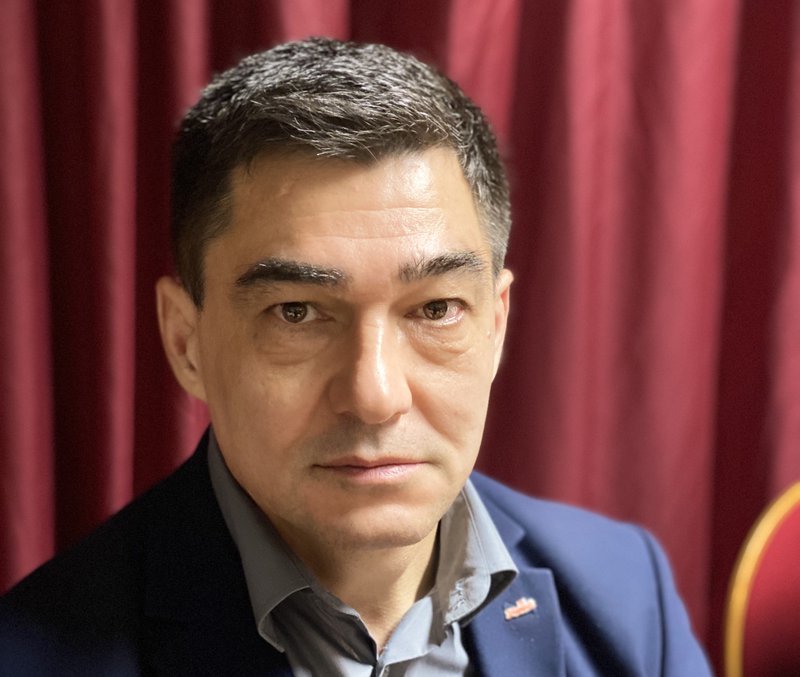
Sergei, how would you appraise the electric current country of Russian society? Since 2014 in that location have been hostilities in Ukraine's Donbas, and now about all Russian politicians and media are talking about a possible full-scale war with Ukraine. Yet pacifist and anti-militarist sentiments are practically absent in society. Why?
The situation today, compared with 2014, has inverse markedly.
First, Russia's repressive apparatus has tightened the screws on social club even further. Both the scale and cruelty of repressions against protesters and activists take grown.
Second, of grade, anti-COVID restrictions [on public gatherings] have played a part. All this has led to the fact that it has become more difficult for people to go to public deportment that put forward any demands.
And then there is another serious reason. In my opinion, people have started treating public protests as a place to clear their conscience fifty-fifty more than before. That is, people get to the streets [only] because they don't want to feel ashamed, not because they expect that the authorities will listen to them! More Russians no longer encounter whatsoever opportunity to exert real influence on the authorities and therefore do not take to the streets.
Moreover, fifty-fifty minimal communication over the system [of a protest] has become hard. I myself served ten days in administrative detention in May last year for retweeting a mail service about a planned [unsanctioned] peaceful protest. Not a single person in Russia can write 'allow'due south concur a protest at this place at this time' without risking their freedom today.
"War is still an abstract thought for the majority of people, specially until information technology starts"
Even earlier a protest itself, you risk paying a fine or getting arrested for several days if y'all don't follow the rules. And if you break the rules of organising a protest on several occasions, you can face criminal prosecution. Vyacheslav Egorov, the last person bedevilled under this provision [in 2019], did just that: when he invited people to come to court to back up [opposition politician] Dmitry Gudkov, this was considered another episode of violating the rules. Egorov was sent to a prison colony for more than than a yr. And so even if people are against the war, they don't protest publicly.
How do you know that people are confronting the war?
Starting time of all, from social networks. The anti-government and pro-liberal section of Russian guild openly speaks out against war.
According to recent surveys past the Levada Center, the bulk of respondents in Russia are afraid of war and do not want it. Although, as contempo polls show, only iv% of Russians believe that the Russian authorities are to blame for escalating the threat of war. [Some 50% of respondents believed that the US and NATO fellow member states were responsible.]
But it is clear that a very large proportion of respondents simply refuse to answer questions about a possible war. In our situation, at that place is no reason to believe that their opinions are distributed in the same manner equally the opinions of those who agreed to answer.
We are talking on the anniversary of Alexey Navalny'south return to Russia and subsequent arrest. Waves of mass protests swept across the country . People came out, despite the danger of going out to protest or the risk of COVID. Since then, there's been silence.
Navalny's return in January 2021 was possibly the concluding large surge of public protest, which ended with 150 criminal cases and 17,000 people detained in iii days.
In Moscow alone, the number of arrests in the 10 days after the January protestation turned out to be, co-ordinate to OVD-Info, 3 times more than in the 15 previous years. The land reacted very aggressively, and when new protests were called in April 2021, far fewer people took to the streets. In addition, the authorities began to abort even people who spread information. Merely you have to admit, Alexey Navalny is a unique effigy, he is a person whom people pinned their hopes on, peculiarly in our culture of leadership, where there is no hope that institutions can deliver, simply in that location is hope that an individual will. Together with the whole fantastic story of the assassination attempt against him, the poisoning and his render.
War, meanwhile, is still an abstract thought for the majority of people, especially until it starts.
Until it starts? And what has been happening since 2014 in the Donbas? And the electric current situation, when Russian troops are gathering around Ukraine, both from the Donetsk region, and now from the Belorussian edge . Does Russian gild really not understand that state of war is not an abstraction?
Information technology depends what role of society you're talking virtually. Well-nigh of society, of course, does not accept this fact. Near people are by and large accustomed to turning a blind middle to what is unpleasant for them. Although many understand that the separatist regions of Ukraine are financially supported past Russia, that tanks and rocket launchers go at that place from Russia. But in the minds of the majority, this is an acceptable trick. Moreover, the Kremlin constantly repeats that everyone does this, it's a normal practice.
And so the state of affairs suits Russian lodge?
The majority in Russia are satisfied, a minority are not. But later on all, near every week the authorities introduce various restrictions, and then that no one hears those who are not satisfied. Sociologists cannot even calculate how realistically satisfied or dissatisfied Russian society is with the situation and the threat of a possible war. Respondents either reject to answer directly questions or give answers they heard from telly.
Why is there practically no anti-war agenda coming from Russian opposition parties and opposition politicians?
I would not say that the Russian opposition is not active on the anti-war agenda. The opposition talks nigh the long-standing state of war with Ukraine as a kind of given. For the aforementioned reasons I mentioned above – Russian society and its individual representatives believe that it is incommunicable to influence these events. And the military rhetoric of recent months is mostly perceived by many every bit a bluff on the part of the Kremlin, every bit something frivolous. This is if we talk well-nigh the threat of a total-calibration war.
Simply the wearisome-burning war that has been going on since 2014 is already perceived as a groundwork, as something familiar, distant. Representatives of Yabloko [liberal opposition political party] also regularly speak virtually the war; [opposition activist] Ilya Yashin periodically speaks virtually this; Vladimir Milov, a Navalny supporter, often speaks on this topic.
But these are divide, sporadic statements, in that location is no organised, big-calibration campaign. And it'southward understandable why: everyone understands that information technology is, unfortunately, incommunicable to organise a campaign that would force the Kremlin to abandon its rhetoric and its assault on Ukraine because of harsh repressions against everyone who disagrees with the Kremlin. Moreover, there are then many problems within the country related to violations of rights and freedoms, with repressions against opposition activists, that the threat of war is perceived every bit ephemeral.
"If a war starts, people will take to the streets in some quantities, merely they will be apace dispersed and the protests will end there"
It seems that seven years of war in Donbas have already become a properties for many?
Unfortunately. And not simply in Russia, just besides in other countries that are not responsible for this assailment. Abroad, it'south a local war that has lasted for many years and is at present perceived equally something normal
In my opinion, a similar, non-existent level of anti-militarist sentiment also existed in the Soviet Union. I was a student when the war in Afghanistan began, and I remember how my classmates wanted to go to war. Even when coffins began to get in from Afghanistan, people only discussed it at dwelling house and remained silent in public.
Yes, I likewise remember the dissatisfaction with the war in Afghanistan equally part of the Soviet intelligentsia'south general dissatisfaction with the regime. No one openly expressed an anti-war position.
The question of solidarity – the ability to take responsibility for something more i'south own interests – is also important here. But in contempo decades, nosotros have become so accepted to believing that something is bad only if it's bad for the states ourselves. We do not want to recall near others, to empathise with others. This was very clear in Russia's involvement in Syria and in the wars in Chechnya, too, unfortunately. Yeah, in that location was a motion against the war in Chechnya, but it was continued, first of all, with Russian losses, and not with the huge losses of the Chechens.
I recall that if a war leads to significant losses on the Russian side, an anti-war movement will sally.
In your opinion, when discussing what is happening in Ukraine do so few people in Russia call it a war ? They talk about certain actions, just they don't call them a war.
Information technology all depends, of course, on who your circles are. If I recall accurately, in 2014 but around 5% of Russians were against the annexation of Crimea. These people chosen and proceed to call the events in Ukraine a war, and take a stand against Russian aggression. Simply a significant number of these people have already left Russian federation.
It turns out that the Russians exercise non care well-nigh someone else's grief?
That's non necessarily the case. Repressions within Russia against, for example, Alexander Gabyshev, the shaman who attempted a protest march from Siberia to Moscow, or Alexey Navalny evoke a much greater response and want to unite than the loss of people in other countries or remote regions. Repressions against Russian Muslims or Jehovah's Witnesses provoke less desire to come up out in solidarity.
In full general, this is a big trouble – Russia does not even have a mass movement for the release of political prisoners, although they are our citizens, and non foreign residents! I think that if a war starts, people will have to the streets in some quantities, but they will be quickly dispersed and the protests will end there. Unless, of class, the war takes on such a scale that it affects the broader population.
Practice you accept any hope for young people in Russia?
Of course, it is the young who are [politically] active. But information technology's also young people who end up in police stations, in the dock, in prison colonies, on the lists of foreign agents and 'extremists'. Then a huge number of immature people who are active with the Navalny network or Russian federation's Libertarian Party have already been forced to leave [the country].
Is in that location a manner out of this savage circumvolve?
I believe in our state and our time to come. All this darkness will somehow lead to a collapse, this unnatural vector of development cannot decide the management of our country for a long time. This, among other things, is what my hope is based on.
And however Russian civil social club is still irresolute, merely equally it was before 2011-12. Back and then, all kinds of non-political associations gained strength, and and then switched to political activities. Now similar processes are underway again, though the state understands this and is trying to build barriers, destroying any possibility of cocky-government. The authorities need to enhance all action to the ground then that goose egg moves without its control.
This makes political activity difficult, but life cannot be stopped completely – and this is too the basis of my hope.
Source: https://www.opendemocracy.net/en/odr/sergei-davidis-anti-war-movement-russia/

Post a Comment for "Is There Any Way to Become Involved With the Military Again?"